Exercise 4: The floor plan
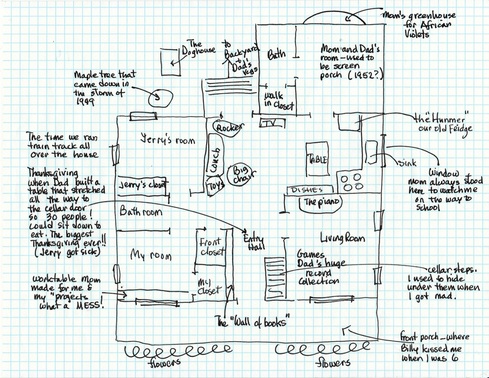
Place is important. In Antiquity, then in the Renaissance, people learned to visualize mansions in their minds and then stored their memories in the rooms and closets of those mansions. That process still works today: Visualize the place one once lived in all it's detail and messiness and memories rise up.
That's why a floor plan can become a tool to stimulate stories of your life. Here's how to do it.
Make a list of all the places you lived in your life. You can draw floor plans for them all. Choose one of them--a place you lived when a child works well to start. You don't need to be an artist, and you don't need to get the dimensions of the rooms perfect. You don't even need to use graph paper, though I like graph paper.
The purpose of this exercise is to help you recall what living in this place was like. As you draw, put in details you remember, and links to stories you'd like to tell.
Start with the inside of the place, but leave lots of room around the edges for annotations. Do the main floor, or the upstairs, or the basement, whatever you like. Later, you can put in the yard, any outbuildings, or even draw a picture of your neighborhood and its landmarks, where your friends live, where the shops were, where you used to play. Be sure to show the doors and least some of the windows as well as closets on your floor plan. Porches and halls too. Label your picture when your done with the dates you lived there and the street address. If you like incorporate your floor plan into your memoirs.
Hints for things to annotate:
As you work, visualize the rooms and put in anything you recall that was significant for you, large or small.
When you are finished, choose one of your annotations and write a whole paragraph, or story sketch about it. File this piece in your notebook. Or, try imagining you are taking a stranger into your home and walk her through the house for the first time, describe what you would point out, what they might see. What might that person say about what they saw?
Don't hesitate to make more plans and to edit them, adding features and annotations as you dredge up memories. This exercise is guaranteed to kindle many visions of the past, both about the places you have lived and the people who shared those spaces with you.
That's why a floor plan can become a tool to stimulate stories of your life. Here's how to do it.
Make a list of all the places you lived in your life. You can draw floor plans for them all. Choose one of them--a place you lived when a child works well to start. You don't need to be an artist, and you don't need to get the dimensions of the rooms perfect. You don't even need to use graph paper, though I like graph paper.
The purpose of this exercise is to help you recall what living in this place was like. As you draw, put in details you remember, and links to stories you'd like to tell.
Start with the inside of the place, but leave lots of room around the edges for annotations. Do the main floor, or the upstairs, or the basement, whatever you like. Later, you can put in the yard, any outbuildings, or even draw a picture of your neighborhood and its landmarks, where your friends live, where the shops were, where you used to play. Be sure to show the doors and least some of the windows as well as closets on your floor plan. Porches and halls too. Label your picture when your done with the dates you lived there and the street address. If you like incorporate your floor plan into your memoirs.
Hints for things to annotate:
- Special furniture or features, e.g. Dad's chair, the piano, a sewing machine, a dollhouse, Mom's desk
- Special names for rooms or features, e.g. the Sun room, the sewing room
- Where did your family spend most of its time? What did they do there?
- Where did your pets sleep?
- Where did you play or do homework or practice?
- Who slept where?
- Don't forget bathrooms, tubs, and showers
- Did you have any sacred places in your house? Or spaces reserved for special guests or events?
- How was the kitchen arranged? Where did you eat? Did people have special seats at table?
- Where did people keep their boots and coats?
- What could you see out of the front window, or your bedroom window?
As you work, visualize the rooms and put in anything you recall that was significant for you, large or small.
When you are finished, choose one of your annotations and write a whole paragraph, or story sketch about it. File this piece in your notebook. Or, try imagining you are taking a stranger into your home and walk her through the house for the first time, describe what you would point out, what they might see. What might that person say about what they saw?
Don't hesitate to make more plans and to edit them, adding features and annotations as you dredge up memories. This exercise is guaranteed to kindle many visions of the past, both about the places you have lived and the people who shared those spaces with you.